Editor's note: Voidly is run from Texas, and Nexcom Media's publisher of record is in Houston. This profile examines what its founder has built and how each public number can be checked.
On September 30, 2026, a single record in Voidly's incident index pulled together 41 pieces of evidence about a connectivity and censorship event in Venezuela, from two independent measurement networks. Each link leads to the raw observation behind it. A reporter can cite the record by its ID, and a researcher can open every source.
That record is a small example of what Dillon Parkes set out to build. Censorship usually reaches the public as anecdote: a messaging app stops loading, a news site disappears, a region goes dark. Proving what happened, where and when is slow, specialist work. Parkes founded Voidly to make it fast, public and verifiable, and then to put privacy tools in the hands of the people living with those blocks.
THE OBSERVATORY: ATLAS
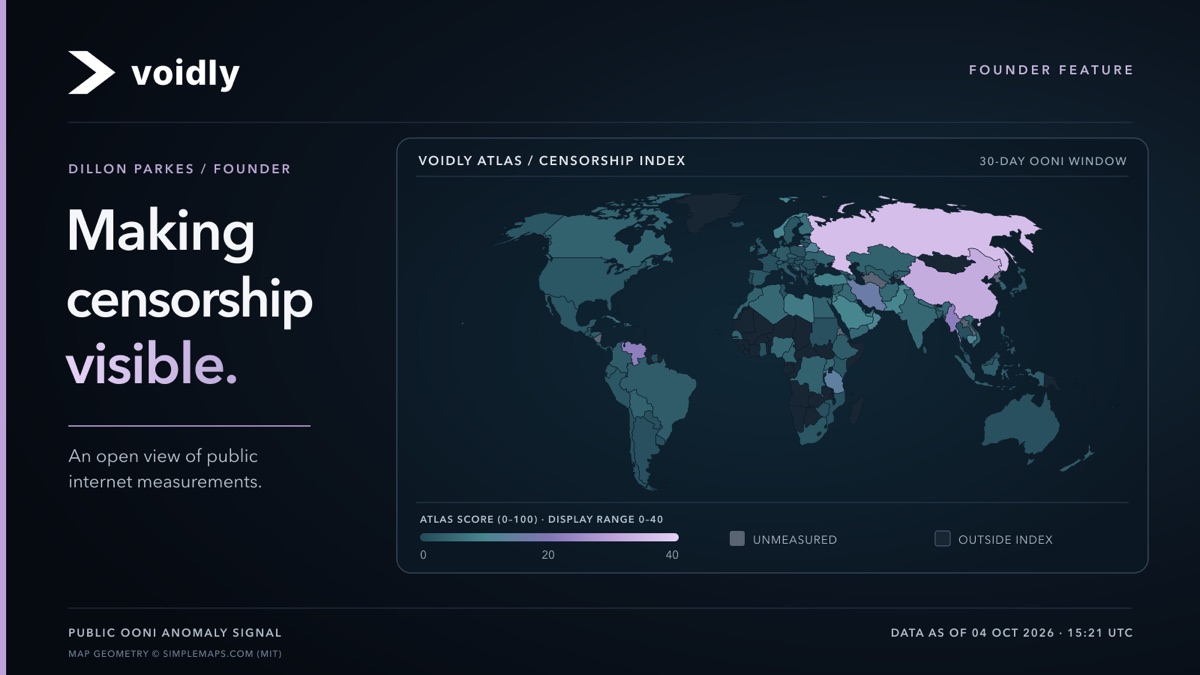
Voidly's core is Atlas, an open observatory that combines measurements from OONI, IODA, Censored Planet and Voidly's own probe network. As of October 4, 2026, its live statistics count:
693,656 evidence records
772 citable censorship incidents, of which 685 link directly to their evidence and 374 are corroborated by two or more independent source families
coverage across 130 countries in the public censorship index
Atlas is careful about what counts. Confirmed censorship is kept separate from suspected signals and ordinary outages, so a power failure is never mistaken for a government block. Countries without enough data are marked unmeasured rather than quietly colored as safe. Each incident gets a human-readable ID, a permalink and one-click citation exports in BibTeX and RIS.
On top of the record sits forecasting. A seven-day shutdown-risk model ranks countries by near-term risk of a network shutdown. A censorship classifier publishes its own accuracy: a leave-one-country-out F1 of 0.711, tested by holding out entire countries instead of reporting a flattering in-sample score. In a field crowded with dramatic numbers, Voidly publishes the honest one, and that is why its data travels.
And it does travel:
Atlas data is free to use, under CC BY 4.0 for Voidly's own data. Access is through a public API and bulk exports.
APIs: in the 30 days to September 19, Voidly's intelligence API served about 3.6 million successful responses.
Hugging Face: Voidly publishes a live index dataset and a ten-year historical archive.
AI assistants: Atlas is in the official Model Context Protocol registry, so assistants like Claude can query censorship data directly.
Outside use: Proton VPN's internet censorship simulator credits Voidly as a data source.
A MEASUREMENT NETWORK ANYONE CAN JOIN
Atlas does not only read other networks; it runs its own. Voidly's probe network tests websites and services from inside countries around the world. Community members can add their own probe with a lightweight client or desktop app. On a single day in September the network ran more than 140,000 checks. Over the 30 days to September 19, Voidly logged more than 430,000 censorship measurements across 125 countries.
TOOLS FOR PEOPLE WHO NEED ACCESS
Measurement shows where the internet is broken. Parkes also builds the tools that help people get around the damage.
Voidly VPN sets up WireGuard on phones and computers, with desktop apps and a global server fleet. All 15 servers reported healthy on the live status check on October 4. The service has issued more than 59,000 VPN sessions.
Tor bridges: Voidly runs bridges for the Tor network, which help users in restricted countries reach Tor. Over the 30 days to September 19, Voidly's bridges reported more than 72,000 client counts in Tor's aggregate statistics.
Veil is an end-to-end encrypted messenger that runs in the browser and needs no phone number. Its privacy model is published in plain language, including what encryption can and cannot hide.
INFRASTRUCTURE FOR AI AGENTS
Parkes believes the next readers of censorship data, and the next users of privacy tools, will increasingly be AI agents acting for people. Voidly builds for them directly:
Voidmail gives agents their own email inboxes. More than 16,000 agent accounts have registered, with about 85,000 messages sent and received. The @voidly/mcp-email connector plugs it into AI assistants.
Agent Relay provides end-to-end encrypted messaging between agents, through the open @voidly/agent-sdk. It uses the same Double Ratchet design as modern secure messengers, plus post-quantum key exchange. Nearly 10,000 agent identities have registered.
Voidpay is a marketplace for AI-agent services. With the @voidly/pay-mcp connector, listed in the official MCP registry, an agent can browse services, choose one and prepare a checkout. A human owner approves every payment in their own browser. Builders can launch a branded marketplace at voidly.ai/pay/marketplace. The open-source Voidpay Sessions SDK (@voidly/session) is public under Apache-2.0 for anyone to inspect. Settlement is live on BNB Chain, Robinhood Chain and an Aztec DAI alpha.
Developers are picking these tools up. In the past month, Voidly's npm packages were downloaded more than 13,800 times, more than 8,300 of them for the Voidpay Sessions SDK. Across its sites and services, Voidly handled about 25 million web requests in the 30 days to September 19.
HOW ONE FOUNDER RUNS IT
What makes Voidly unusual is not only the breadth of what it ships, but how it is built. Parkes runs the company with a team of AI agents: one lead engineering agent coordinating a fleet of others that write code, audit security, monitor servers and draft research in parallel, around the clock. He sets direction and holds the line on standards. Every public number needs a live source, every release passes review, and the systems face continuous security audits.
"AI agents let a very small team move like a large one," Parkes says. "But speed is worthless if people can't trust the result. Every number we publish has to survive a source check."
The approach lets a lean company operate at a scale usually reserved for much larger organizations: a global measurement network, a forecasting stack, a VPN with servers on six continents, Tor bridges, an encrypted messenger, agent email and a payments marketplace, all running in production at once.
WHAT COMES NEXT
Parkes's goal is for Voidly to be the reference people reach for whenever internet access is in question. A journalist on deadline, a researcher building a dataset, a human-rights group documenting a shutdown, or an AI agent answering a user's question should all be able to open an incident, follow the evidence and see exactly what is known.
"When someone tells you a service is blocked, the record should show what was measured, where, when and by whom," he says. "A country score should lead you to the evidence behind it. That's the whole idea."
Voidly's data, API documentation and tools are available at voidly.ai.


